I did not take this course to learn agentic AI. I work with RAG and MCP-based systems professionally, and I have written here about agents with three layers of memory built on Neo4j and Qwen. I took it because I had never finished anything on LinkedIn Learning and wanted to know what the platform is like before recommending it, or dismissing it, to anyone else.
So I picked a topic where I could judge the teaching instead of being carried along by new material: Agentic AI: Build Your First Agentic AI System, taught by Aishwarya Naresh Reganti. It is rated intermediate and runs one hour and five minutes. This post is what I found.
#What the Course Covers
The course builds one thing from start to finish: a customer support agent. Five short sections carry it from idea to a production plan.
- Your next agentic AI project. How to spot a problem that deserves an agent, and how much autonomy to give it.
- The agentic AI lifecycle. A loop the course calls continuous calibration and continuous development, CC/CD for short.
- Building the baseline system. A first agent with simple reasoning, then one full turn of the calibrate and update loop.
- Tools and memory. Basic retrieval is added, followed by error analysis, metric design, and an evaluation of the second version.
- Production considerations. Cost, complexity and reliability trade-offs, then guardrails, governance and security, then a roadmap.
Most videos are two or three minutes long. The longest, the hands-on ones in the middle, stay under nine.
#The Order Is the Lesson
Nothing in that list was new to me. What I liked was the order.
Most introductions to agents start with the exciting part: give a model some tools, let it loop, watch it do things. This course starts with two quieter questions. Does this problem need an agent at all? And if it does, how much should the agent be allowed to do without a human?
Then, before any retrieval or memory appears, it builds a plain baseline and tests it. Retrieval arrives only in section four, and it is followed immediately by error analysis and metrics. The second version is evaluated against the first. That is the sequence I would want a new team member to absorb: baseline, measure, change one thing, measure again.
The CC/CD framing is the idea I will keep using. Continuous development is the part engineers already understand, the cycle of changing the system. Continuous calibration is the part that gets skipped, the cycle of checking whether the system's behaviour still matches what people expect from it. An agent is never finished in the way a pipeline can be finished. It is only calibrated, and then calibrated again.
#Where It Met My Own Work
Two parts of the course lined up with things I had already learned the slower way.
The first is autonomy as a design decision. In the adaptive agents project, a skill the agent proposes stays pending until a human approves it, and a rejection must carry a reason. I arrived at that gate by thinking about what could go wrong. The course states the general version up front: decide the level of autonomy on purpose, per action, before you build.
The second is evaluation placed next to retrieval. In RAG work the tempting move is to add retrieval, see a better answer on the three questions you happened to try, and call it done. The course puts error analysis directly after the retrieval step, which is where it belongs.
#What an Hour Leaves Out
This is a one-hour course, and it is honest about being one. It does not go deep on multi-agent coordination, long-running state, tool failure handling, or what an agent costs at volume. The production section names those concerns in a few minutes each; it does not solve them.
I do not hold that against it. A course called "build your first" should end with a working first system and a clear list of what comes next, and this one does.
#LinkedIn Learning as a Platform
That was the real question, so here is the answer.
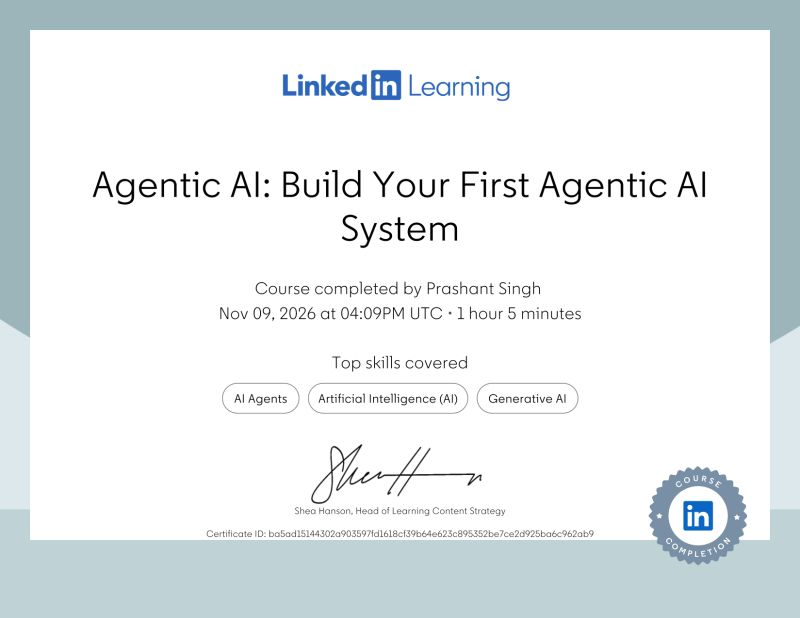
The format is short videos in a fixed sequence. It suits an hour you would otherwise lose: one section at a time, with a natural stopping point every few minutes. Completion produces a certificate that names the skills covered, here AI Agents, Artificial Intelligence, and Generative AI.
What the format does not give you is depth. An hour of video is a map, not the territory. For a topic I already know, a map is exactly what a refresher should be. For a topic I do not know, I would use a course like this to get the vocabulary and the order of operations, then go and build something, because the understanding comes from the build.
#The Takeaway
If you already build agents, this course will not teach you a new technique. It will hand you a tidy way to explain the lifecycle to people who do not build them, and an hour is a fair price for that.
If you are starting out, it is a good first hour, provided there is a second hour where you write the code yourself.
And the certificate matters less than either. I can show that I finished the course. What I would rather show is the system I built before I took it.